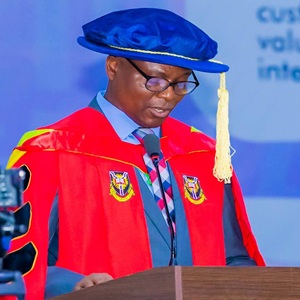
"NIGERIA IS A LAND FLOWING WITH OIL AND GAS," SAYS UI DON
A Professor of Organic and Environmental Geochemistry at the University of Ibadan, Professor Oluwadayo Olatunde Sonibare has submitted that Nigeria is a land flowing with oil and gas.
He made this submission while delivering the 602nd Inaugural Lecture of the University of Ibadan on behalf of the Faculty of Science.
The title of the lecture was: “A Land Flowing with Oil and Gas: Where is the Oil Kitchen?”
Professor Sonibare said that Nigeria is one of the countries in the world that are blessed with enormous hydrocarbon resources, adding that the Niger Delta basin is one of the major regressive deltaic sequences and hydrocarbon provinces of the world.
The Don disclosed that following the first discovery in 1956, exploration in the Niger Delta was stepped up and by 1958, oil was discovered in twelve areas in the Niger Delta of which Oloibiri, Afam, and Bomu were the most promising and today, the basin has an estimated reserve of about 36.97 billion barrels of crude oil and natural gas reserves of about 210.54 trillion cubic feet.
He stated that Nigeria also has one of the largest coal and lignite deposits in Africa with an estimated coal and lignite reserve of 2.75 billion metric tonnes and 70 million metric tonnes respectively, first discovered in Nigeria in 1909 by the Mineral Survey of Southern Nigeria near Udi in Enugu State, Nigeria.
According to Professor Sonibare, Nigeria is also abundantly blessed with tar sands deposits which are located within the eastern margin of the Dahomey Basin and the outcrop is about 120km long and 6km wide, cutting across the states of Ogun, Ondo, Edo and Delta.
He noted that most of these resources have not been explored or are underexplored, saying that apart from the hazards associated with gas flaring, it is obvious that the natural gas resource, coal, oil shale and tar sand bitumen in Nigeria are grossly underutilized.
He decried the lack of adequate programmes for the exploration of natural gas, coal, and the abundant tar sands deposits in Nigeria as bitumen from tar sand is useful for road construction and as feedstock for the petrochemical industry.
The Don stated that the massive importation of heavy oil/bitumen for road construction and petrochemical feedstock is puzzling, considering Nigeria's abundant deposits in the southwestern region.
He lamented Nigeria's heavy reliance on crude oil, which, according to him, has led to the neglect of other vital natural resources.
Therefore, the inaugural lecturer called for the development of a comprehensive policy to harness these resources, given the volatile nature of the oil market.
He stated that utilising local bitumen deposits and capturing natural gas can conserve foreign exchange, create jobs and promote sustainable resource management, urging the Nigerian government to prioritise these initiatives to secure the country's economic future and promote sustainable development.
The Don advocated university-industry partnerships to sponsor university research and provide necessary grant and resources, stressing that they are vital tools for translating research into practical solutions.
He reiterated that fostering these partnerships, barriers between academia and industry would be broken, and mutual benefits would be promoted to drive innovation, economic growth, and national development.
Professor Sonibare called on the federal government to rigorously pursue a zero-flare policy and invest in technology to capture and utilise the flared gas and diversify revenue streams by exploring and exploiting other natural resources.
The Inaugural Lecture was the twenty-fifth in the series for the 2024/2025 academic session.