UI DON DESCRIBES IONISING RADIATION AS AN INVISIBLE FRIENDLY FOE
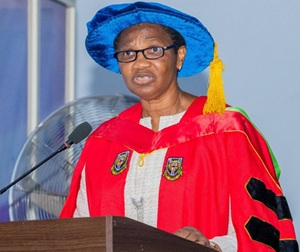
A Professor of Radiation and Health Physics, Professor Janet Ayobami Ademola has described ionising radiation as an “invisible friendly foe” whose benefits and dangers can only be properly understood, controlled and managed through science.
She made this description while delivering the 613th Inaugural Lecture of the University of Ibadan on behalf of the Faculty of Science.
The lecture was titled: “Invisible Friendly Foe Made Visible Through Science.”
Professor Ademola explained that ionising radiation is one of the most intriguing paradoxes of modern science because it has enormous benefits when carefully applied but can also be harmful when poorly understood or improperly controlled.
According to her, radiation science lies at the intersection of physics, medicine, environmental science and public health.
She explained that ionising radiation is not a modern invention but a natural part of the environment, stating that cosmic rays constantly bombard the Earth from outer space, while naturally occurring radionuclides such as uranium, thorium and radon exist in rocks, soil, water and even within the human body.
The Don stressed that one of the greatest achievements of science has been the development of technologies capable of detecting and measuring radiation beyond the reach of human senses, disclosing that instruments such as Geiger-Müller counters, ionisation chambers and personal dosimeters have made it possible to monitor radiation exposure and ensure safety.
According to her, radiation science has provided the foundation for environmental monitoring, radiation protection and the safe application of ionising radiation in medicine, agriculture, industry and scientific research.
She added that through knowledge, measurement and control, radiation has been transformed from a hidden threat into a beneficial tool for humanity.
The Professor of Radiation and Health Physics clarified that all matter is composed of atoms and that unstable atomic nuclei naturally release energy in the form of radiation in an attempt to attain stability and that radiation, which can be classified into electromagnetic and particulate radiation exists everywhere in the environment.
She identified cosmic radiation, terrestrial radiation and radioactive substances within the human body as major natural sources of ionising radiation, while medical procedures, industrial activities and research applications constitute major man-made sources.
The lecturer, however, warned that despite the enormous benefits of ionising radiation, excessive exposure can be harmful to human health and the environment. She said that high doses of radiation can damage body tissues and lead to health conditions such as radiation burns, radiation sickness and cancer.
Professor Ademola highlighted the numerous applications of ionising radiation, especially in medicine where it is used for diagnostic imaging and cancer treatment, adding that radiation also plays important roles in industrial quality control, agriculture, food preservation and scientific research.
She stressed the importance of radiation protection, explaining that international safety standards are built on the principles of justification, dose limitation and optimization.
She advocated practical radiation protection measures, which include reducing exposure time, increasing distance from radiation sources and using appropriate shielding materials.
Professor Ademola also highlighted environmental radioactivity, noting that radioactive substances are present and naturally occur in the soil, rocks, building materials, food and water, identifying radon gas as the largest contributor to natural radiation exposure, which according to her, is the second leading cause of lung cancer after smoking.
She called for strengthened radiation monitoring and regulation, increased investment in radiation science research and improved public awareness on the benefits and risks of ionising radiation.
The Don asserted that ionising radiation is neither inherently good nor bad, but stressed that its impact depends on human understanding, regulation and responsible application, saying that science provides humanity with the knowledge and tools required to transform potential danger into societal benefit.
The Inaugural Lecture was the tenth in the series for the 2025/2026 academic session.