UI DON CALLS FOR RETHINKING OF FOOD AND NUTRITION SECURITY IN NIGERIA
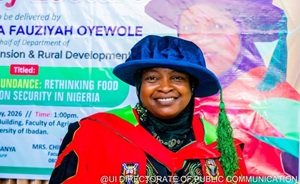
A Senior Lecturer in the Department of Agricultural Extension and Rural Development (Home Economics Unit), University of Ibadan, Dr. Mojisola Fauziyah Oyewole, has called for a comprehensive rethinking of food and nutrition security in Nigeria in order to address the growing challenges of hunger, malnutrition and unequal access to food.
She made this call while delivering a Faculty Lecture of the Faculty of Agriculture, University of Ibadan on behalf of the Department of Agricultural Extension and Rural Development.
The lecture was entitled: “Hunger and Abundance: Rethinking Food and Nutrition Security in Nigeria.”
Dr. Oyewole explained that food remains the most fundamental requirement for human survival as it sustains life, supports growth, strengthens immunity and fuels intellectual and physical productivity.
She noted that throughout human history, societies have continually struggled to secure sufficient food for their populations, with persistent challenges such as famine, scarcity and unequal access to food significantly shaping human development.
The lecturer stated that despite the world’s capacity to produce sufficient food, hunger continues to persist, describing the situation as one of the most pressing moral and developmental challenges of modern times.
According to her, food security goes beyond the availability of food alone.
She stressed that food systems must provide not only adequate calories, but also nutritious diets capable of promoting healthy living and sustainable human development.
Dr. Oyewole explained that insecurity in many farming communities has negatively affected agricultural activities as farmers are often displaced from their farmlands, thereby reducing food production and threatening livelihoods.
She added that poverty and economic inequality have also limited access to nutritious food for many households, especially among vulnerable populations.
The lecturer decried food losses and waste, describing the development as major challenges within Nigeria’s food system, adding that poor storage facilities, inadequate transportation networks and weak market structures also contribute significantly to post-harvest losses across the agricultural value chain.
The Food Security expert also lamented that climate change has continued to pose serious threats to food security through irregular rainfall patterns, flooding, drought and other environmental challenges capable of disrupting agricultural productivity.
She added that weak food systems and poorly coordinated value chains further worsen the nation’s food and nutrition challenges.
The lecturer restated that rethinking food and nutrition security in Nigeria requires a holistic and integrated approach which would combine agriculture, health, education, environmental sustainability and social policy.
She, however, warned that such an approach must recognize the critical role of farmers in ensuring food production and availability, while also acknowledging the influence of women in improving household nutrition and food utilization.
According to her, addressing hunger amid abundance in Nigeria requires the strengthening of the food distribution systems, improving rural infrastructure and reducing post-harvest losses.
She, therefore, advocated increased investment in agricultural productivity, nutrition education and poverty reduction programmes as essential steps towards achieving sustainable food and nutrition security.
Dr. Oyewole also called for the promotion of indigenous foods, the empowerment of women and the expansion of digital extension services, noting that these measures would improve the affordability, accessibility and utilization of nutritious foods among Nigerians.
She stressed the need for collective commitment towards building a food system that guarantees both food availability and nutritional well-being for all citizens and submitted that deliberate policies, effective institutions and continuous investment in agricultural and rural development are required in achieving sustainable food and nutrition security.